Shifting Perspectives is a master's thesis by Lennart Schiffers that researches the role of communication in climate transformation. The website presents insights from a designer’s perspective through methods and artifacts, including observations, facilitations, creative writing, and a reflective chatbot. Through the artifacts, the project seeks to translate interdisciplinary knowledge and express a necessary shift from a reactive to a proactive, systemic approach to climate change mitigation and its communication.
About the master thesis
Contextual background
The need to mitigate climate change in Germany is growing and putting increased pressure on policymakers to act. However, the climate transformation required to reduce greenhouse gas emissions is bringing significant changes in people's everyday life. Although there is a high level of awareness about climate change within German society, the necessary behavioral changes are meeting with significant resistance due, among other things, to conflicting values, norms, and attitudes toward the measures. Therefore, it is crucial to understand how policymakers can communicate climate change mitigation measures to the public to better progress towards the net-zero goal of 2045.
Research approach
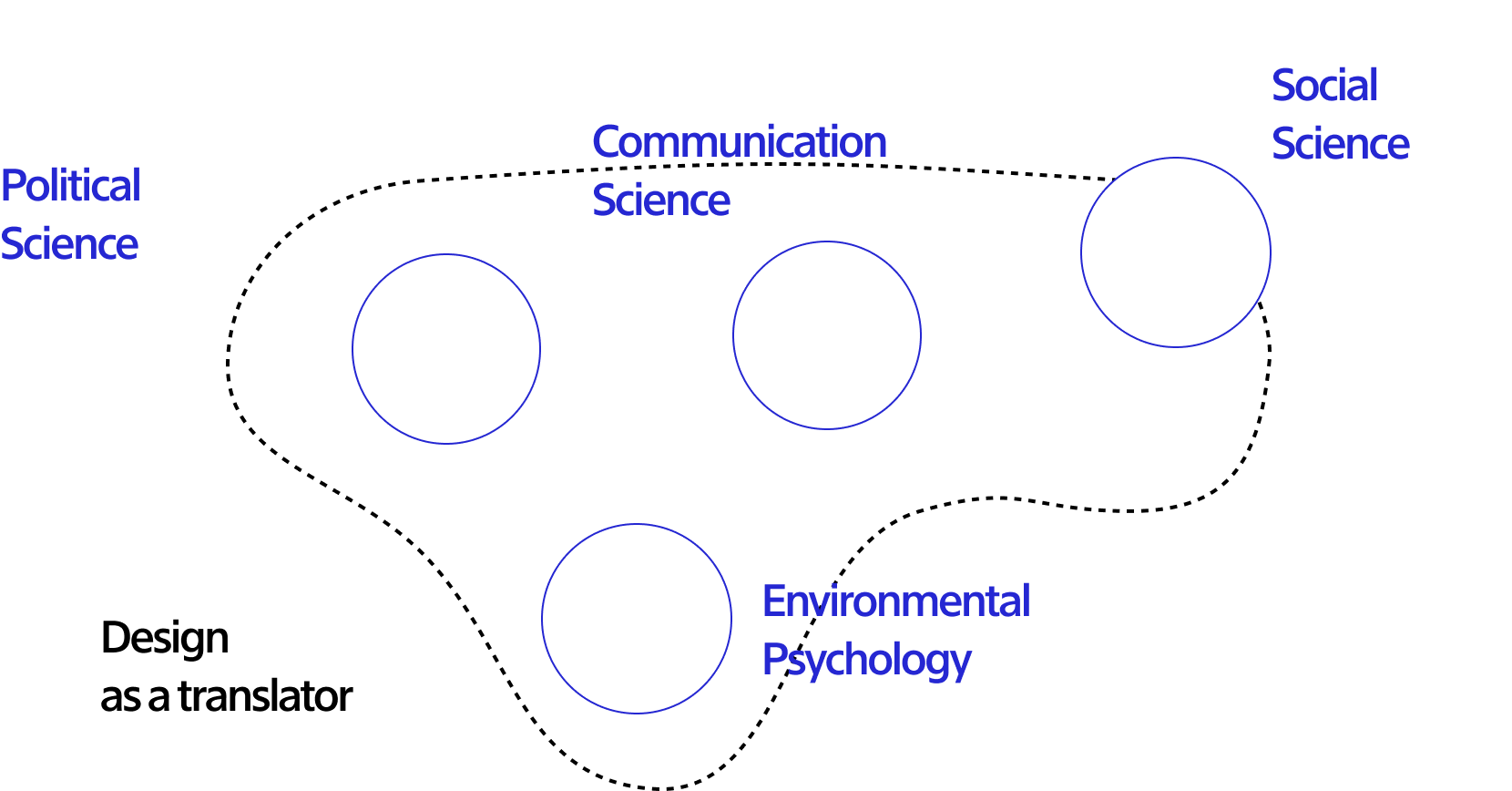
For the design and research thesis, a mixed-methods approach was used to identify possible solutions to the research question: “What strategies can policymakers use to communicate climate change mitigation measures to the public to better progress towards the net-zero goal 2045?” As a foundation, an interdisciplinary approach was selected, moving across the fields of communication, political, and social sciences, as well as the design domain. To engage in interdisciplinary research as a designer, I had to take on multiple roles throughout the project. These consisted of activities such as observing and supporting a climate district by joining their meetings and events for over five months, facilitating workshops with experts from the environmental field and experts on everyday life from Germany to understand their perception of climate measures and analyzing literature and case studies from an interdisciplinary field and lastly, incorporating the classical design role into these spaces I interacted with through posters, presentations, workshop setup, and new artifacts such as the website and its content to start new interactions.
Reflection
The master's thesis started by investigating the Gebäudeenergiegesetz (the Building Energy Act) and its pitfalls in communication. Through an extended analysis of the transportation sector and its potential measures to mitigate further CO2 emissions, the systemic issue of communication shortcomings could be identified. An interdisciplinary research approach helped to analyze approaches for meaningful and effective communication. To bring the insights into use, it was necessary to explore different artifacts using a strong participatory approach. These helped apply the insights from current research and inform the research. As a result, adapting by taking on different roles enabled further interaction in the field, exploring different strategies, and continually scrutinizing current solutions. However, the dependencies of interacting in such a dynamic environment should not be underestimated, as external influences may influence possibilities and outcomes.