How can museum installations support climate communication? At the exhibition “What If,” this question was explored with fellow students. Visitors co-designed utopian news articles that addressed societal shifts in norms or values, as well as climate adaptation. Further, the effects of hopeful messages were explored, and how this medium could be used for further projects to support systemic climate communication.
What if — an interactive museum installation on future narratives
Setting
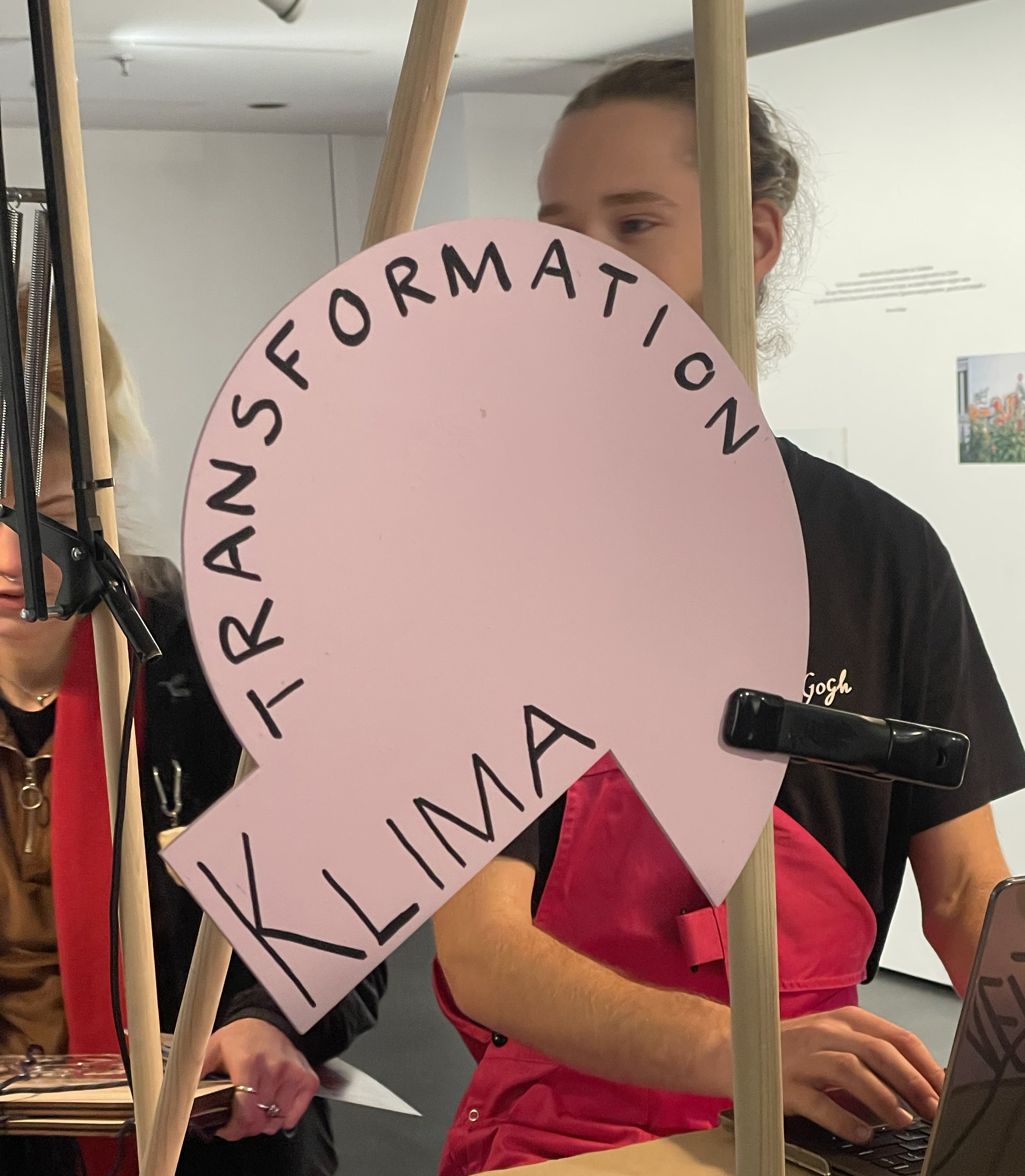
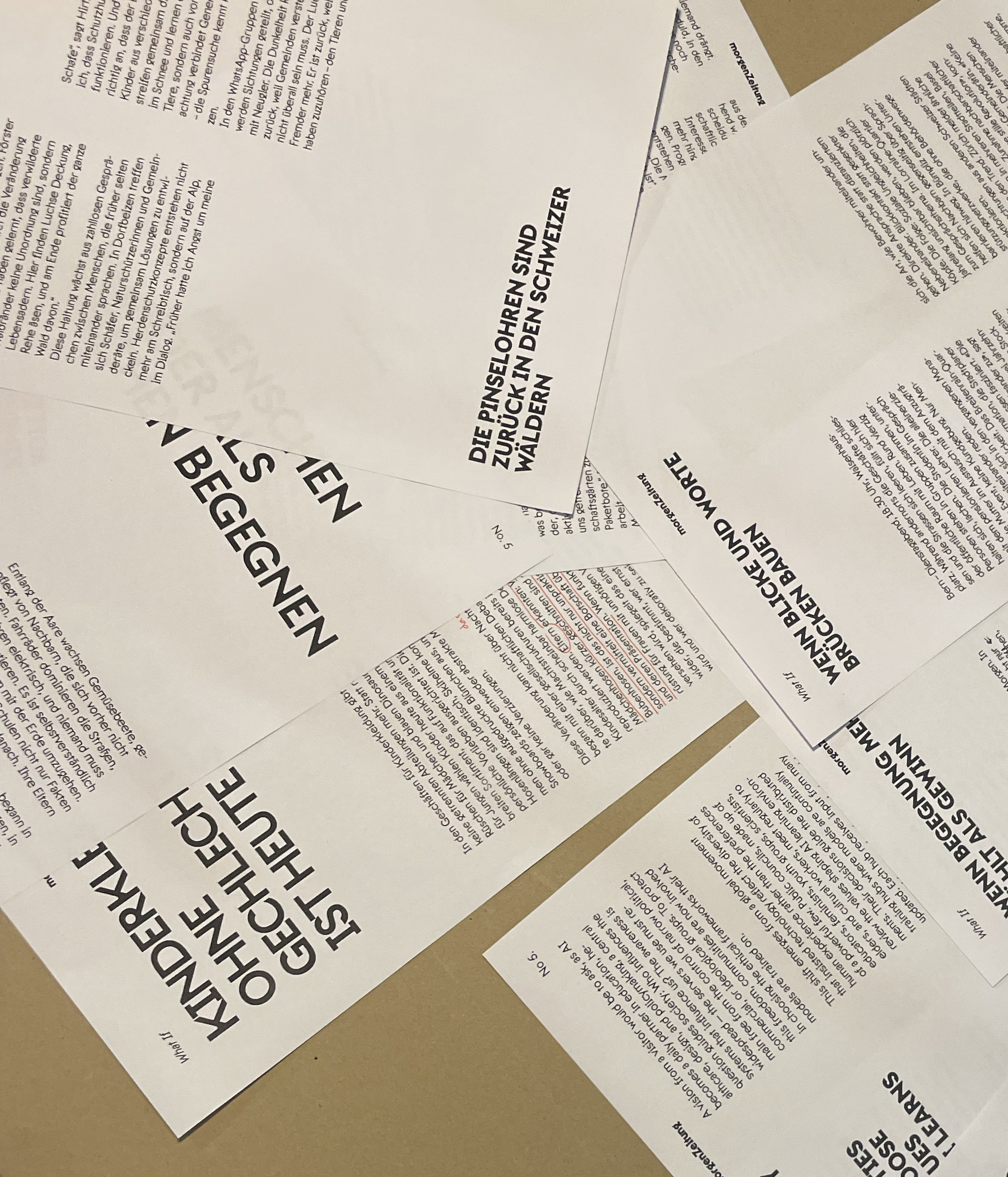
At the Kornhausforum in Bern’s city center, the exhibition with the title “Was wäre wenn? Vom Spekulieren und Handeln für die Zukunft” (“What if? Speculating and acting for the future”) took place from 28th of November 2025 to the 1st of February 2026. The “morgenZeitung,” developed with fellow students and our supervisors, Karin Fink and Florian Hauswirth, sought to answer “What if” by creating an interactive newspaper booth to envision alternative futures by taking on the editor’s role on weekends and for special events. Across eight sessions, the results of the interaction with the visitors could be observed. Two further sessions were conducted at the social design conference in Lucerne to test the concept. The format invited visitors and passersby outside the museum to engage in conversation about what they would like to read in a utopian newspaper article. Through the conversations, the editor would create prompts and the first bullet points for the newspaper with the help of a chatbot such as Claude. Afterward, visitors could check whether the list aligns with their thoughts and priorities, or adjust the bullet points before the final article is printed. Once the article is printed, visitors can edit it throughout the day by striking out passages or writing notes in the margins. At the end of each day, the final newspaper is printed by copying the edited versions.
Relevance to my thesis
The installation was relevant to climate communication, as constructive thinking can challenge current standards and identify solutions unconsciously, making it a useful tool for strengthening acceptance of the climate transformation. Furthermore, as discussed in the chapter on pluralistic ignorance by Miller (2023), increasing the visibility of climate change and its solutions by discussing constructive futures helps mitigate pluralistic ignorance. By using a utopian vision and fostering positive emotions, the increase in visibility may be further strengthened. Heitfeld & Thiele (2024) reinforces this point, noting that besides beliefs, groups also share emotions and amplify them through discussions, resulting in similar motivations.
General outcomes
The main topics the visitors‘ utopian articles strived for were: (1) that the climate crisis should be a shared responsibility and the issue itself should not be seen as a siloed issue but rather as a whole, (2) that we within the society should communicate more with each other, (3) that media outlets may want to focus more on positive news, (4) that we could learn from the values that existed in the past and (5) Notably, visitors also emphasized the individual responsibility such as a CO2 calculator which seems to contradict point (1). These results strengthen previous findings, especially for the role of collective framings, the role of positive emotions within advocacy, and the overall role of communication within groups.
Reflection
Beyond media outlets, smaller projects such as the “MorgenZeitung” and more specific initiatives that advocate for climate change mitigation and its positive impacts may help foster more frequent and systematic discussion of positive narratives in public discourse. The installation showed that a utopian newspaper booth can serve as an entry point for a conversation about sensitive, negative issues, such as the climate crisis and its mitigation efforts.
For future formats, it may be interesting to bring the booths to public events, for example, within a climate district such as in Freiburg im Breisgau. The local positioning there could help to understand the public better by understanding their wishes and visions, and translate them into strategies for future events and campaigns. Also, during conferences, the format may be used to collectively iterate on the future of the conference topic. For that, question cards could provide an easier entry point by making it more tangible before the first interaction with an editor.
Sources
Heitfeld, M., & Thiele, K. (2024). _Wahrnehmung und Akzeptanz von Klimapolitik in Deutschland_.
Miller, D. T. (2023). A century of pluralistic ignorance: what we have learned about its origins, forms, and consequences. _Frontiers in Social Psychology_, _1_. [https://doi.org/10.3389/frsps.2023.1260896](https://doi.org/10.3389/frsps.2023.1260896)